


Flow Studio Preloader

We improve thermodynamic properties

Our CN improvers (nitrate, isoamyl nitrite, isoamyl nitrate, and 2-ethylhexyl nitrate) are sourced as pure fluids from a commercial vendor. They are all highly-graded, with reported purities of 98% and above, and have been analysed with chromatographic methods. 
The future of Cetane Booster is here

The future of Cetane Booster is here

The cetane number of a diesel fuel is used to measure the ignition quality of a fuel for engines. It is critically important to the speed of the engine’s combustion, as it affects the delay in the self-ignition. This delay is caused by the time that it takes for the fuel to vaporise and mix with the air in the engine cylinder, before reacting with the oxygen once it is vaporised. 


More Info

Unleash the beast

Cetane boosters/amyl nitrite are great for starting up the reaction, and they’re a minimal part of the mixture. I think it goes up to 3% of it. You can use Iso-propyl Nitrite, but I definitely prefer using amyl instead. It works great with diesel engines especially. 


FAQ

Frequently Asked Questions

Cetane Booster

I’ve got an Oliver Tiger Major, so this stuff is great at getting the old girl to keep going, even after this long. Vintage stuff needs to be taken care of a bit more gently, so having something like Engine Booster just means that the cetane’s boosted enough to make ignition a lot kinder on the old girl. Its engine’s custom-made, so it needs a specific type of fuel that’s really tricky to get a hold of, but this stuff makes it way easier to mimic. 

Our CN improvers (nitrate, isoamyl nitrite, isoamyl nitrate, and 2-ethylhexyl nitrate) are sourced as pure fluids from a commercial vendor. They are all highly-graded, with reported purities of 98% and above, and have been analysed with chromatographic methods. 

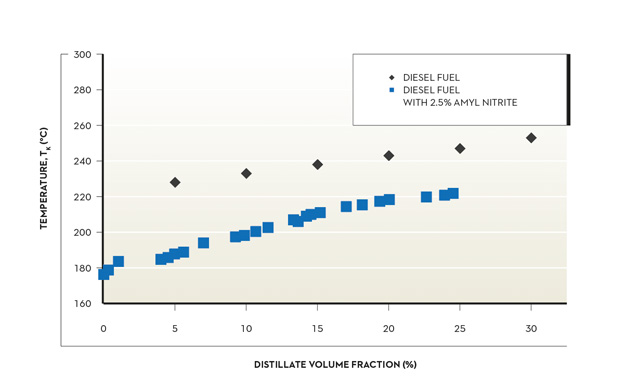
In a rapidly evolving landscape that factors in environmental concerns, along with political and economic changes, we can expect to see new or different sources of compression-ignition fuels with different CN standards. Because of this, understanding the CN through ADCs will be crucial to fully understanding these fuels’ properties, particularly their volatility. This will especially focus on diesel-fuel blends that contain ‘therapeutic’ amounts, ranging in the 500-1000 ppm area, such as amyl nitrate, isoamyl nitrate, and 2-ethylhexyl nitrate. By continuing to refine our CN-boosting additives, we hope to continually improve these thermodynamic properties and effectively replace standard fuel properties with enhanced ones.

So what it is that cetane reacts to the kerosene in the fuel and helps the ether combust at a smoother rate. So then what happens is that you find the cetane shortens the ignition delay, so I don’t have to worry about anything like smoking problems. Especially since the more average/’cheaper’ diesel fuel tends to have a lower cetane number (somewhere in the 30s), stuff like Rush boosts those numbers up to the 50s and even 60s. And then this is good because it means that the fuel has more oxygen to burn, so it can go even faster than normal, with less faff.

It’s been amazing for my RC planes, the extra boost is just really satisfying to watch when I’m using them. It’s especially great for the more tricky custom engines I have, that don’t tend to work as well with just your standard diesel. AND it reduces exhaust emissions too, so that’s an added bonus. Basically, this stuff is like miracle juice!